
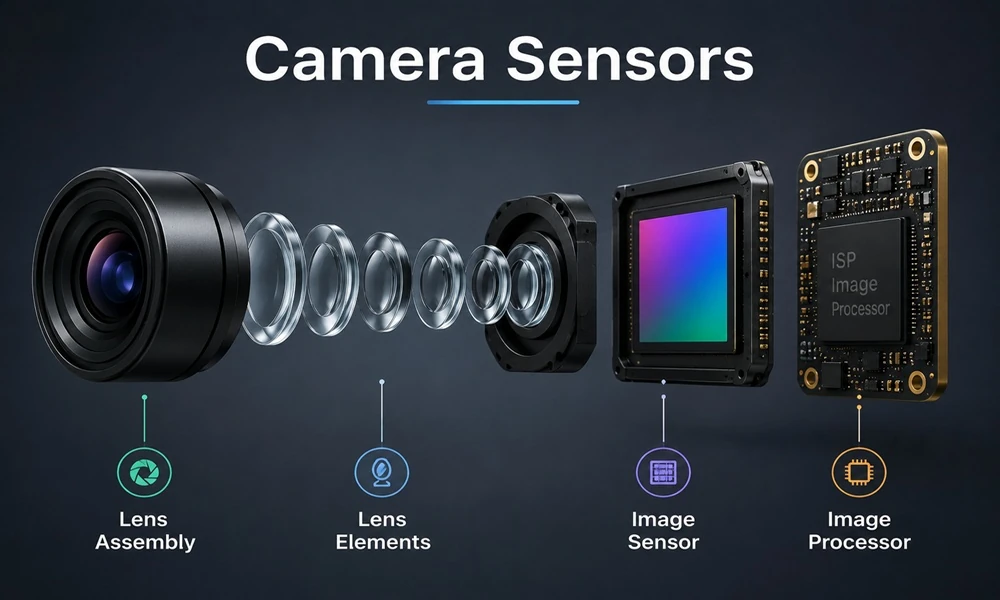
The engineering trajectory of mobile photography has historically been defined by a fundamental physical limitation: spatial volume. Unlike traditional standalone imaging equipment, which utilizes massive chassis enclosures to house full-frame physical sensors and deep multi-element glass groups, mobile devices must capture light within ultra-thin, highly constrained internal layouts. To overcome these dimensional constraints, manufacturers have transitioned away from simply relying on mechanical scaling, turning instead to deep structural redesigns of optical matrices and advanced computation.
The culmination of this architectural evolution is visible in contemporary elite flagships, where massive multi-megapixel arrays work alongside ultra-bright lenses to capture unprecedented environmental detail. Devices like the samsung s26 ultra illustrate how hardware manufacturers pack desktop-grade optical components into a highly pocketable form factor. However, integrating components of this scale-including wide physical apertures and complex periscope arrays-fundamentally reshapes the research and production budgets of mobile platforms, establishing a direct mathematical baseline for the overarching s26 ultra price in global markets.
The Physics of Light Gathering: Aperture and Sensor Dimensions
To properly evaluate a modern mobile camera system, one must first dismantle the myth that high megapixel counts automatically equate to superior image output. The foundational determinant of any optical system’s capability is its capacity for light gathering, mathematically governed by the physical dimensions of the primary sensor and its matching aperture ratio.
The F1.4 Aperture Engineering Milestone
In typical micro-optics, expanding the maximum aperture of a camera system introduces extreme geometric distortions and severe chromatic aberrations along the edges of the frame. To mitigate this, advanced optics utilize specialized multi-element lenses made of flexible composite polymers molded to sub-nanometer tolerances.
In the primary module of the samsung s26 ultra, this engineering challenge is addressed by pairing a large primary matrix with an ultra-bright $f/1.4$ physical aperture. This wide opening represents a substantial upgrade over older $f/1.7$ designs, allowing up to $47%$ more physical light to flood the sensor structure. This immense surge in photon collection dramatically reduces reliance on artificial software exposure algorithms, preserving natural micro-textures, lowering noise levels in low-light environments, and delivering a true, organic shallow depth-of-field effect.
Deconstructing the 200MP Optical Matrix
When dealing with an ultra-dense 200-megapixel layout packed onto a small mobile substrate, individual pixel sites must be miniaturized to sub-micron footprints. Without advanced structural intervention, placing millions of sub-micron photo-sites so close together can cause light leakage between adjacent pixels, leading to color distortion and digital noise.
Advanced Sub-Micron Isolation
To prevent this degradation, modern flagship sensors use advanced physical barriers between individual pixels. These specialized structures form a deep grid that traps incoming photons within their designated sub-pixel walls, ensuring that light hitting a specific color filter does not bleed into neighboring rows. This advanced isolation preserves pixel purity even under harsh, direct midday sunlight.
Flexible Pixel Binning Architectures
Operating a camera natively at 200 megapixels requires massive data bandwidth and generates files that can easily exceed 50 megabytes per shot, creating processing delays and consuming storage quickly. To optimize daily operations, the imaging pipeline uses dynamic pixel binning:
- 12-Megapixel Default Mapping: For standard snapshots, the camera processes data by grouping a 16-in-1 matrix of adjacent pixels to act as a single, large super-pixel. This mode excels in dark environments by combining light data from multiple points to maximize brightness and clear out digital artifacts.
- 24-Megapixel Everyday Mode: Accessed via specialized camera assistant sub-menus, this configuration applies a balanced binning approach. It captures significantly crisper architectural lines, textile weaves, and distant details without clogging local storage or slowing down shot-to-shot response times.
- Full 200-Megapixel Capture: This mode opens up the entire sensor array for maximum resolution, capturing raw environmental data. It gives landscape photographers and editors immense flexibility to crop deep into an image during post-processing without losing sharpness.
The Quad-Camera Layout: Focal Length Versatility
An elite mobile imaging setup cannot rely entirely on a single primary lens. To provide professional-grade utility, the hardware deployment scales across a versatile quad-lens configuration, providing seamless optical coverage across vastly different focal lengths.
| Lens Configuration | Sensor Resolution | Physical Aperture | Primary Structural Function |
|---|---|---|---|
| Primary Wide-Angle | 200 Megapixel | $f/1.4$ | High-res detail capture, advanced low-light performance |
| Ultra-Wide Sensor | 50 Megapixel | $f/2.2$ | 120-degree landscape capture, macro focusing, distortion correction |
| Medium Telephoto | 10 Megapixel | $f/2.4$ | Native 3x optical magnification, optimized portrait separation |
| Periscope Telephoto | 50 Megapixel | $f/2.9$ | Native 5x optical zoom, long-range stabilization matrix |
This balanced distribution of sensors ensures that the system can cover everything from macro tracking just centimeters away to long-range telephoto capture. The integration of high-resolution 50-megapixel sensors across both the ultra-wide and 5x periscope modules ensures that color rendering, dynamic range, and resolution profiles remain uniform as the user zooms through different focal lengths.
Silicon Integration: The NPU and Computational Enhancements
The raw data captured by an ultra-dense 200-megapixel sensor matrix is essentially an unfinished digital blueprint. Transforming these billions of raw electrical data points into a polished, viewable frame requires massive real-time computational power.
Driving this processing pipeline is custom silicon architecture, spearheaded by the Snapdragon 8 Elite Gen 5 platform. This high-efficiency 3nm processor features an isolated, upgraded Neural Processing Unit (NPU) that works directly alongside a dedicated image signal processor. As soon as the shutter is triggered, the system runs advanced object-aware semantic segmentation.
Instead of applying uniform sharpening or color adjustments to the entire image, the system identifies individual elements within the frame-such as human eyes, distant foliage, fabric textures, or night sky gradients-and optimizes exposure, contrast, and noise reduction for each segment independently. Additionally, high-speed computational pipelines support hardware-level Horizon Lock, which counteracts rapid physical rotations during video capture to deliver perfectly stable, gimbal-like 8K video at 30 frames per second.
The Economic Relationship: Innovation vs. Retail Valuation
Integrating these advanced manufacturing steps-including molded $f/1.4$ glass components, high-density 200MP titanium isolation barriers, dual-periscope lens assemblies, and advanced 3nm processing silicon-requires massive capital investment. These steep component costs directly dictate the manufacturing baseline before shipping, distribution, or local taxes are applied.
For tech consumers analyzing the global landscape, evaluating the base s26 ultra price reveals that premium mobile devices are priced as highly capable, pocketable production studios. When evaluating this investment, savvy buyers recognize that the upfront cost covers a unified hardware suite that replaces multiple standalone devices, including entry-level DSLR bodies, a range of heavy telephoto lenses, and external electronic stabilizers.
The New Frontier of Mobile Optical Architecture
The evolution of mobile imaging from simple pinhole lenses to large-format multi-sensor matrices represents a major triumph of modern micro-engineering. By combining the photon-gathering efficiency of a wide $f/1.4$ aperture with the versatility of a 200-megapixel sensor and a high-speed NPU pipeline, devices like the samsung s26 ultra demonstrate that physical space limitations no longer prevent professional-grade capture.
As computational imaging algorithms continue to advance alongside highly specialized sensor layouts, the reliance on traditional, heavy camera gear will continue to decrease. The modern flagship smartphone has successfully solidified its position as a dominant force in professional mobile content creation, offering uncompromised optical power that fits right in the palm of your hand.